
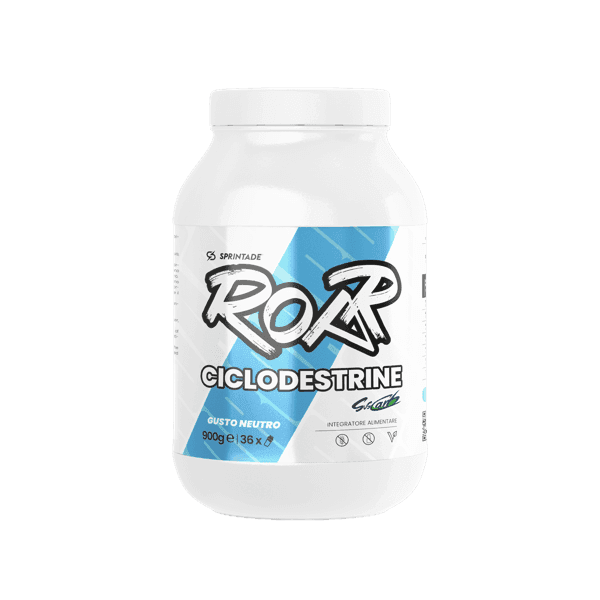


Cyclodextrin Pure HBCD SusCarb®

30,75 €
ROAR Pure HBCD SusCarb® Cyclodextrins
Technical energy for intense training and endurance sports
Sprintade® ROAR Cyclodextrins is a powdered carbohydrate dietary supplement formulated exclusively with SusCarb® Dextrin highly branched cyclic dextrins, also known as Highly Branched Cyclic Dextrin or HBCD.
Its single-ingredient formula, neutral taste and high solubility make ROAR Cyclodextrin a particularly versatile source of carbohydrates for cyclists, runners, triathletes and athletes engaged in intense or long-duration training.
A 25 g serving provides 23.5 g of carbohydrates and 93 kcal, with a minimal amount of sugars. It can be taken before exercise or during training and competition, as part of a personalised nutritional strategy.
What are highly branched cyclodextrins?
Highly branched cyclodextrins are carbohydrates obtained through the enzymatic conversion of starch. They have a branched molecular structure, a high molecular weight and generally lower osmolarity than solutions containing the same concentration of glucose or small-molecule carbohydrates.
These characteristics make it possible to produce concentrated energy drinks whilst maintaining a relatively low osmotic pressure. In sporting contexts, this can promote gastric emptying and make it easier to consume carbohydrates during prolonged exercise.
Cyclodextrins are therefore particularly valued when the following are required:
- carbohydrates that mix easily;
- a drink with a mildly sweet taste;
- high solubility in water;
- flexibility in designing an energy plan;
- a practical solution for use before or during sport.
What makes SusCarb® Dextrin special?
SusCarb® is the HBCD raw material developed by ZymeBase and obtained from waxy maize starch through an enzymatic cyclisation process.
According to the specifications published by the manufacturer, SusCarb® has:
- a high average molecular weight, approximately between 60,000 and 100,000 Da;
- a uniform molecular weight distribution;
- a high degree of branching;
- low osmolarity in solution;
- excellent solubility and clarity;
- a neutral taste and the absence of any characteristic odours;
- very low levels of oligosaccharides.
The manufacturer also states that SusCarb® has a higher percentage of α-1,6 bonds than other highly branched cyclic dextrins and common maltodextrins. The high degree of branching is one of the structural characteristics studied for its potential influence on digestion and glucose release.
Cyclodextrins or maltodextrins: what is the difference?
Both are sources of carbohydrates derived from starch, but they have different molecular structures.
Maltodextrins consist mainly of linear chains of glucose with a variable molecular weight. HBCDs, on the other hand, have a highly branched cyclic structure and a generally higher molecular weight.
The practical advantage of cyclodextrins is not simply that they are ‘absorbed more quickly’. Their main distinguishing feature is the ability to produce a drink with a high concentration of carbohydrates and relatively low osmolarity, a characteristic that may be useful during intense or prolonged sporting activities.
However, the digestive response varies from person to person and must be assessed during training sessions, particularly when consuming large amounts of carbohydrates.
What does scientific research say about HBCDs?
The available research mainly concerns the category of Highly Branched Cyclic Dextrins and not necessarily the specific raw material SusCarb®.
A study by Takii and colleagues analysed the gastric emptying rate of drinks containing HBCD, finding a favourable response compared with carbohydrates of lower molecular weight. This result is consistent with the low osmolarity typical of solutions based on highly branched cyclodextrins.
A small study conducted on athletes also compared the intake of HBCD with that of maltodextrin during exercise. The intake of 15 g of HBCD was associated with a smaller increase in perceived exertion at certain points during the test. However, the limited number of participants means that caution is required when generalising the findings to all athletes.
Other studies have evaluated HBCDs during endurance exercises, observing potential benefits relating to gastrointestinal tolerability, perceived fatigue and the physiological response to exertion.
Overall, the available literature is promising, but is still based on small-scale studies. The most robust and directly measurable characteristics of HBCDs remain their high molecular weight, low osmolarity and high solubility.
Why choose ROAR Cyclodextrins?
ROAR Cyclodextrins is designed for those seeking a technical, essential and easily customisable source of carbohydrates.
The formula contains only SusCarb® Dextrin, a highly branched cyclic dextrin, with no added flavourings or colourings. Its neutral taste means it can be used on its own or alongside other ingredients in your nutritional strategy.
It is particularly suitable for:
- road cycling, gravel cycling and mountain biking;
- long-distance running and trail running;
- triathlon;
- team sports;
- high-intensity training;
- high-volume strength training or bodybuilding sessions;
- competitions and training sessions where it is necessary to consume carbohydrates in liquid form.
The formula is also vegan, gluten-free and lactose-free.
How to take ROAR Cyclodextrin
Dissolve 2 scoops, equivalent to 25 g of product, in 200–300 ml of water. One serving provides 23.5 g of carbohydrates.
The drink is best consumed:
- before training, to increase carbohydrate availability;
- during exercise, spreading the intake gradually throughout the session;
- as part of a combined strategy with water, electrolytes and other sources of carbohydrates.
For activities lasting longer than 60–90 minutes, the serving can be included in the overall calculation of carbohydrates consumed per hour. Requirements vary depending on duration, intensity, body type, fitness level, environmental conditions and individual tolerance.
High-carbohydrate strategies should be tested gradually during training. It is not advisable to try a high dose for the first time during a competition.
How to make a personalised energy drink
Thanks to its neutral taste, ROAR Cyclodextrins can form the basis of a customisable energy drink.
It can be combined with:
- electrolytes, particularly in hot conditions or when sweating heavily;
- a source of fructose, when aiming to implement a strategy involving carbohydrates absorbed via different intestinal pathways;
- amino acids or proteins, depending on the type of training;
- creatine, as part of your daily supplementation plan.
For intakes exceeding approximately 60 g of carbohydrates per hour, endurance athletes often use combinations of glucose or glucose polymers with fructose. This strategy must be personalised and accompanied by appropriate gut training.
Key nutritional information
A 25 g serving contains:
- Energy: 389 kJ / 93 kcal
- Carbohydrates: 23.5 g
- of which sugars: 0.25 g
- Fat: 0 g
- Protein: 0 g
- Salt: 0.03 g
- Package contents: 900 g
- Approximate number of servings: 36
⎯
Frequently Asked Questions about Cyclodextrins
What are HBCD cyclodextrins?
HBCDs are highly branched cyclic dextrins obtained from starch through enzymatic processes. They are soluble carbohydrates characterised by a high molecular weight and low osmolarity in solution.
What is SusCarb® Dextrin?
SusCarb® is a proprietary HBCD raw material produced by ZymeBase. It is distinguished by its high branching, uniform molecular weight distribution, solubility and neutral taste.
How many carbohydrates are there in a serving?
A 25 g serving of ROAR Cyclodextrins provides 23.5 g of carbohydrates and 93 kcal.
When should cyclodextrins be taken?
They can be taken before or during physical activity. In endurance sports, they are generally incorporated into a strategy of staggered replenishment throughout the exercise.
Are cyclodextrins better than maltodextrins?
There is no single carbohydrate that is best in every situation. HBCDs have a higher molecular weight and allow for low-osmolarity solutions with a less sweet taste. Maltodextrins remain an effective and generally more economical source of energy.
Are cyclodextrins slow-release carbohydrates?
They should not automatically be considered ‘slow’ carbohydrates. They are digestible glucose polymers. The branched structure and characteristics of the specific raw material may influence their digestion, but the metabolic response also depends on the dose, concentration and presence of other nutrients.
Are they suitable for people with a sensitive stomach?
Their low osmolarity may help with the management of concentrated drinks, but it does not guarantee the absence of gastrointestinal discomfort. Tolerance must be assessed gradually during training sessions.
Can I add mineral salts?
Yes. ROAR Cyclodextrins’ neutral taste makes them suitable for preparing a personalised drink with electrolytes, depending on sweat loss and environmental conditions.
Can I combine them with fructose?
Yes. In endurance sports, combining it with fructose can be used to create a mixture of carbohydrates that can be absorbed via different intestinal pathways. The ratio must be adjusted according to the expected hourly intake and individual tolerance.
Does ROAR Cyclodextrin contain flavourings or colourings?
No. It is a single-ingredient formula with a neutral taste, containing no added flavourings or colourings.
Is the product vegan?
Yes. ROAR Cyclodextrins is labelled as vegan, gluten-free and lactose-free.
- Wilburn, Machek and Ismaeel, a review of the ergogenic effects of HBCD
- Shiraki et al., HBCD and exercise performance
- Takii et al., HBCD and gastrointestinal disturbances during cycling
- Takii et al., ‘Fluids containing a highly branched cyclic dextrin influence the gastric emptying rate’, International Journal of Sports Medicine, 2005.
Related products
Beta Alanine
Creatina Monoidrato Ultrapura

BCAA 4:1:1