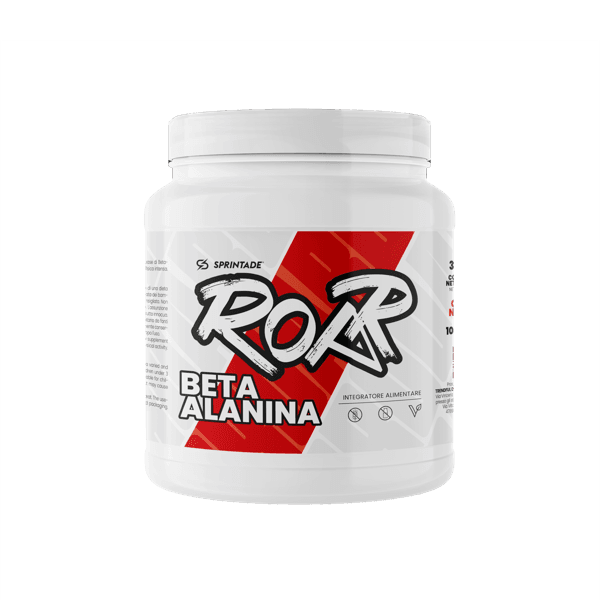


Beta Alanine

15,00 €
REDUCE TRAINING FATIGUE
ROAR Beta-Alanine: what is it and what is it used for?
Beta-alanine is a non-essential amino acid best known for its role in the production of muscle carnosine, a dipeptide formed from beta-alanine and L-histidine.
Carnosine is naturally present in skeletal muscle, with particularly high concentrations in type II muscle fibres, which are involved in the most intense and explosive exertions.
But why supplement with beta-alanine rather than carnosine?
The availability of beta-alanine is one of the main limiting factors in the synthesis of muscle carnosine. For this reason, the ongoing supplementation of beta-alanine has been extensively studied as a strategy to increase carnosine concentrations in the muscles.
And this is precisely where its relevance to sport lies.
Beta-alanine, carnosine and muscle fatigue: how do they work?
During high-intensity training, muscle metabolism leads to a progressive accumulation of H+ ions, associated with a decrease in pH within the muscle.
Carnosine acts as an intracellular buffer, helping the muscle to counteract these changes in pH.
Increasing the availability of beta-alanine may help to boost muscle carnosine stores and, precisely because of this mechanism, its supplementation is being studied primarily in relation to muscle fatigue and the ability to sustain high-intensity exercise.
Scientific research has, in fact, observed increases in muscle carnosine following periods of beta-alanine supplementation, with potential benefits particularly in intense activities where muscle acidosis can be a limiting factor.
Beta-alanine against lactic acid?
Beta-alanine is often described as a supplement ‘against lactic acid’. The concept is intuitive, but physiologically it is more complex.
Beta-alanine does not directly eliminate lactate.
Its benefit stems instead from its ability to increase, over time, the availability of muscle carnosine, which is involved in the buffering systems that help the muscle manage increased acidity during intense exertion.
It is therefore more accurate to discuss beta-alanine, carnosine and muscle buffering capacity.
What are the benefits of beta-alanine?
Beta-alanine has become one of the best-known ingredients in sports nutrition precisely because of its unique mechanism of action.
Supplementation has been studied primarily for:
- to promote an increase in muscle carnosine;
- to support the muscle’s buffering capacity;
- to counteract some of the mechanisms associated with fatigue during intense exercise;
- to support the ability to sustain high-intensity exercise;
- to support training sessions characterised by a significant anaerobic component;
- to contribute to the nutritional strategy of athletes engaged in particularly intense training.
The effects studied are particularly relevant for intense exercise of relatively short or intermediate duration, during which the accumulation of H+ ions can contribute to the onset of fatigue.
Beta-alanine and muscle cramps: can it help?
Beta-alanine and muscle cramps are sometimes linked, mainly because both topics are frequently discussed in relation to fatigue and intense training.
However, it is important to distinguish between them.
Cramps during physical activity are complex phenomena and can be influenced by numerous factors. Beta-alanine should therefore not be regarded simply as a ‘cramp-preventing’ supplement.
Its known mechanism of action is different: by progressively increasing the availability of carnosine in the muscles, it primarily affects the muscle’s buffering capacity during intense exertion.
For those seeking solutions to cramps, fatigue and a drop in performance during training, it is therefore important to distinguish the role of beta-alanine from that of hydration, electrolytes and exercise management.
Beta-alanine and carnosine: what is the difference?
Beta-alanine is not carnosine, but it is one of its two key components.
Carnosine is, in fact, a dipeptide consisting of:
Beta-alanine + L-histidine = Carnosine
In muscle tissue, the availability of histidine is normally greater than that of beta-alanine. It is precisely for this reason that the availability of beta-alanine is the main limiting factor in carnosine synthesis.
Regular intake of beta-alanine therefore allows for a gradual increase in muscle carnosine levels.
What is the role of carnosine in muscles?
Muscle carnosine performs various biological functions, but in sport it is best known for its role as an intracellular buffer.
As exercise intensity increases, the ability to regulate changes in muscle pH becomes particularly important.
It is precisely this relationship between carnosine, pH and muscle fatigue that explains why beta-alanine has become one of the most widely studied ingredients in supplementation for high-intensity sports.
Beta-alanine: when should you take it?
Beta-alanine is very common in pre-workout supplements, but it does not necessarily have to be taken only before a workout.
Unlike substances characterised by an acute effect, its use is primarily linked to the gradual increase in muscle carnosine concentrations.
For this reason, the scientific literature mainly examines protocols involving daily intake over several weeks.
The key word is therefore consistency: the aim is not simply to take beta-alanine a few minutes before training, but to create, over time, conditions conducive to increasing muscle carnosine levels.
Beta-alanine before or after training?
One of the most frequently studied questions concerns the best time to take beta-alanine.
Before or after training?
Since the main aim of supplementation is to gradually increase the levels of carnosine in the muscles, the timing of a single dose is generally less important than the regularity of intake.
For this reason, beta-alanine can easily be incorporated into an athlete’s daily routine.
Why does beta-alanine cause a tingling sensation?
The characteristic tingling sensation caused by beta-alanine is known as paraesthesia.
It is a temporary sensation that can occur, particularly when taking relatively high doses in a single intake, and may affect the face, neck, hands or other parts of the body.
An important point to note:
more tingling does not mean greater effectiveness.
Paraesthesia is linked to the method and amount of beta-alanine taken in a single dose and is not an indicator of increased muscle carnosine levels.
Beta-alanine and creatine: can they be taken together?
Beta-alanine and creatine are among the best-known ingredients in sports supplementation, but they work through different mechanisms.
Creatine primarily acts within the creatine-phosphocreatine energy system, whilst beta-alanine is used by the body to increase the availability of muscle carnosine.
Precisely because their mechanisms are different, they are frequently included in the same supplementation strategy or combined within pre-workout formulas.
For which sports is beta-alanine beneficial?
The way beta-alanine works makes it particularly beneficial in sports where high levels of intensity are reached and muscle fatigue can quickly become a limiting factor.
These include:
- bodybuilding and weight training;
- cross-training and functional training;
- cycling;
- high-intensity running;
- HIIT;
- combat sports;
- team sports;
- disciplines characterised by intense and repeated exertion.
However, not all forms of exercise respond in the same way to supplementation. Scientific research, in fact, shows particularly interesting results in high-intensity exertion of moderate duration.
Pure Beta-Alanine: essential supplementation for intense training
Pure Beta-Alanine is designed for those who wish to supplement with pure beta-alanine powder without relying on the quantities typically found in pre-workout formulas.
An essential formula for those seeking an ingredient recognised for its ability to increase muscle carnosine levels and for its potential role in supporting the muscle’s capacity to cope with high-intensity training.
⎯
Your training allies: reduce fatigue
Beta-alanine at a glance
What is beta-alanine used for?
It is used by the body to synthesise carnosine, and taking it as a supplement can increase carnosine levels in the muscles.
What is carnosine used for?
In the muscle, amongst other functions, it acts as an important buffer against changes in pH, such as when a significant amount of lactic acid accumulates.
Carnosine is found in high concentrations in skeletal muscle and is particularly abundant in Type II fibres, which are involved in rapid, high-intensity exertion. Scientific research indicates that the main limiting factor for the synthesis of carnosine in muscle is not the availability of L-histidine, but that of beta-alanine. For this reason, increasing the availability of beta-alanine through supplementation may promote a gradual increase in muscle carnosine concentrations.
Are beta-alanine and carnosine the same thing?
No. Beta-alanine is one of the two amino acids used to produce carnosine.
Does beta-alanine reduce fatigue?
Its use has been studied in relation to muscle buffering capacity and performance during high-intensity exercise, where the accumulation of H+ ions can contribute to the onset of fatigue. Beta-alanine therefore has the potential to help reduce the sensation of fatigue during training.
Does beta-alanine help with cramps?
Not directly. Cramps have multiple causes and should not be confused with the mechanisms of fatigue, which can be influenced by an increase in muscle carnosine; nevertheless, beta-alanine can provide valuable support
When should beta-alanine be taken?
It is primarily intended for long-term use: consistency in intake is generally more important than the exact timing in relation to training. As a pre-workout supplement, beta-alanine can be taken 30 minutes before training.
Why does beta-alanine cause a tingling sensation?
This is known as paraesthesia, a temporary sensation mainly associated with taking high amounts in a single dose.
Can beta-alanine and creatine be taken together?
They are different substances that act through different mechanisms and are frequently used together in sports supplementation.
Related products
Creatina Monoidrato Ultrapura
Maltodextrin

BCAA 4:1:1