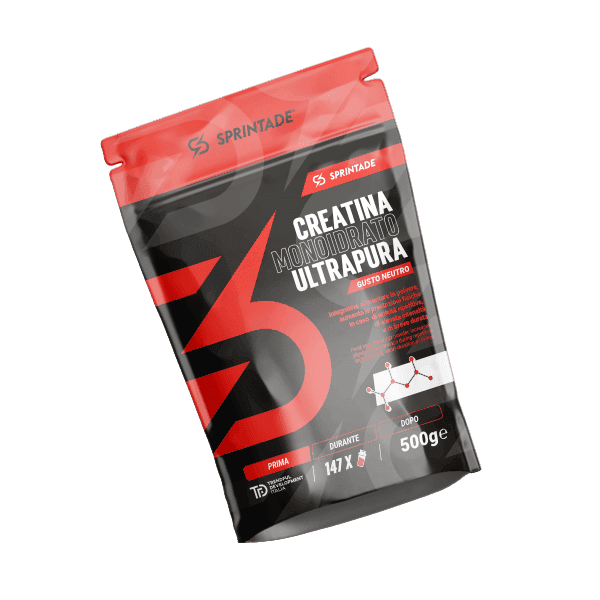


Creatina Monoidrato Ultrapura

23,20 €
Sprintade® Creatine Monohydrate Ultrapure is a food supplement suitable for adult athletes who engage in high-intensity physical activity. Creatine increases physical performance in successive bursts of short-term, high-intensity exercise*.
*The beneficial effect is obtained with a daily intake of 3,4 g of creatine. The product is intended for adults only.
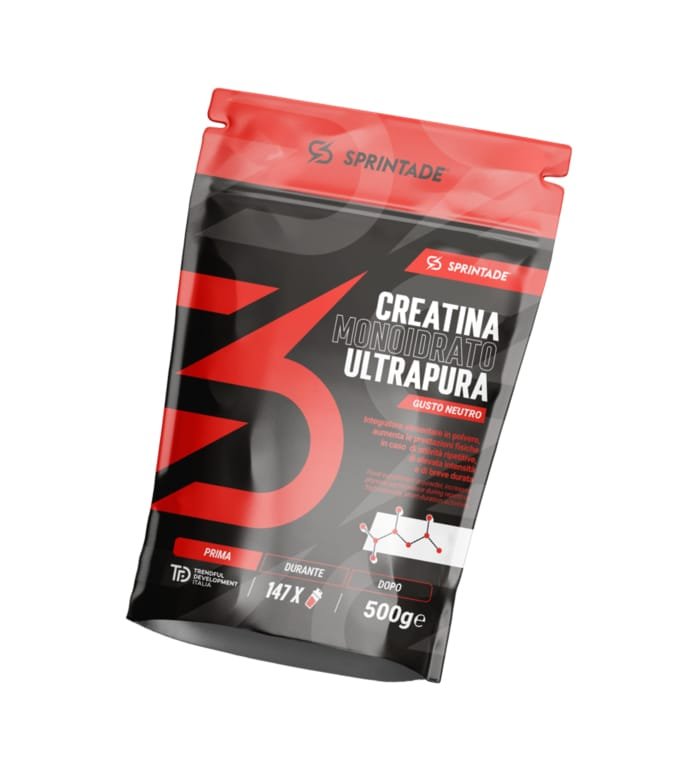
Ingredients: Creatine monohydrate (micronized).
Serving size: 1 serving
Serving per pack: 88
How to use: Take 3.4g of product per day (1 heaped scoop) in at least 300ml of water.
Warnings: Do not exceed the recommended daily dose. Keep out of reach of children under 3 years of age. Food supplements should not be used as a substitute for a varied diet. Do not use during pregnancy or breastfeeding, in children or for prolonged periods without consulting your doctor. A varied and balanced diet and a healthy lifestyle are important. Suitable for athletes’ diets for no more than one month. Store tightly closed in a cool, dry place.
Sprintade Ultrapure Creatine Monohydrate (200 Mesh)
Much more than just a gym supplement
Sprintade Ultrapure Creatine Monohydrate is a powdered dietary supplement formulated exclusively with 200-mesh micronized creatine monohydrate, free from flavorings, sugars, or unnecessary additives.
The raw material undergoes analytical testing to verify microbiological compliance and check for heavy metals. It is an essential choice for anyone seeking a pure, soluble creatine suitable for daily use.
Creatine is often associated solely with the gym and strength gains. In reality, the creatine-phosphocreatine system plays a role in ATP regeneration across numerous high-energy-demand tissues, including the muscles and the brain.
For this reason, contemporary scientific research is investigating creatine not only in the context of strength sports but also in cycling, active aging, cognitive function, sleep deprivation, and specific areas of women’s health.
Available in the following sizes:
- 300 g – 100 servings (3 g each)
- 500 g – over 166 servings (3 g each)
What is creatine?
Creatine is a substance naturally present in the body, concentrated primarily in skeletal muscle. Some of it is produced from the amino acids arginine, glycine, and methionine, while varying amounts are obtained through animal-based foods, particularly meat and fish.
Inside cells, creatine can be converted into phosphocreatine, a store of phosphate groups used to rapidly regenerate ATP.
ATP is the primary energy unit used by cells. During a sprint, a set of resistance exercises, or intense acceleration, immediate ATP supplies are rapidly depleted. Phosphocreatine contributes to its regeneration during periods of sharply increased energy demand.
Consistent creatine supplementation allows for a progressive increase in total muscle creatine and phosphocreatine stores, particularly in individuals starting with lower levels.
Why choose creatine monohydrate?
Creatine monohydrate is the form most widely studied and used in scientific research. Its efficacy is supported by hundreds of studies focusing on strength, power, the ability to repeat high-intensity efforts, and training adaptations.
More expensive chemical forms—or those marketed as “advanced”—have not convincingly demonstrated superiority over creatine monohydrate in terms of increasing muscle stores.
Monohydrate therefore remains the gold-standard choice due to:
- the volume of available research;
- its efficacy in boosting muscle creatine stores;
- stability;
- safety of use;
- its quality-to-dosage-to-cost ratio.
What does “200-mesh creatine” mean?
The “200-mesh” rating describes the powder’s degree of micronization. It indicates particles fine enough to pass through a sieve with 200 openings per linear inch.
A fine particle size offers practical advantages:
- better dispersion in liquids;
- fewer coarse granules;
- more uniform consistency;
- easier mixing;
- a more pleasant daily intake experience.
Micronization does not transform creatine monohydrate into a different chemical form, nor does it automatically imply higher bioavailability. It primarily improves the powder’s physical characteristics and ease of use.
Ultra-pure creatine tested for heavy metals
Creatine quality depends on more than just particle size. It is also important to verify the raw material’s compliance and check for potential contaminants.
Sprintade Creatine Monohydrate undergoes analytical testing—including checks for heavy metals—to ensure compliance with applicable limits.
The term “tested for heavy metals” indicates that the product is analyzed to verify its compliance. This does not necessarily mean the absolute analytical absence of any trace, but rather compliance with the strict safety parameters in place.
The formula contains a single ingredient: micronized creatine monohydrate.
Creatine, strength, and high-intensity performance
Creatine enhances physical performance during repetitive, high-intensity, short-duration activities. The beneficial effect recognized in the European Union is achieved with a daily intake of 3 grams of creatine.
This benefit applies to activities such as:
- resistance training (lifting weights);
- repeated sets in the gym;
- sprinting;
- accelerations;
- changes of pace;
- starts;
- jumping;
- team sports;
- disciplines characterized by repeated explosive efforts.
Creatine does not act as a stimulant and does not produce an immediate sensation comparable to that of caffeine. Its effect stems from a progressive increase in the body’s stores and must therefore be evaluated in the context of regular intake.
Creatine and muscle growth
Creatine is not a protein and does not directly build new muscle tissue. However, it can improve the ability to sustain training volume, intensity, and quality.
Over time, the ability to complete more repetitions, maintain higher power output, or recover better between closely spaced efforts can foster more significant adaptations to strength training.
Scientific reviews show that, when combined with a resistance training program, creatine can contribute to greater gains in strength and lean mass compared to training alone.
Some of the initial weight gain may result from water retained within the muscle cells. This is not necessarily subcutaneous water retention; the increase primarily involves intracellular water and accompanies the rise in muscle creatine stores.
Creatine and memory: what do studies show?
The brain is a highly metabolically active organ that utilizes the creatine-phosphocreatine system to help maintain cellular energy availability. A systematic review and meta-analysis of randomized studies has identified potential beneficial effects of supplementation on memory, with particularly interesting results observed in older adults and individuals with lower dietary creatine intake.
The evidence is not uniform across all cognitive functions: memory, attention, processing speed, and executive functions do not necessarily respond in the same way.
The most promising results appear to emerge when cerebral energy metabolism is under increased demand—for example:
- in cases of low initial reserves;
- in vegetarians or vegans;
- with advancing age;
- during periods of intense mental fatigue;
- in conditions of insufficient sleep.
Creatine should not be presented as a substance capable of automatically improving memory and concentration in every individual. However, the literature suggests a potential role that extends beyond just muscle tissue.
Creatine, insufficient sleep, and mental performance
A crossover study published in 2024 evaluated the effect of a high, acute dose of creatine during sleep deprivation. Researchers observed changes in brain metabolism associated with improvements in certain cognitive performance metrics.
This is an interesting result because it suggests that creatine availability may become more critical when the brain is under high energetic stress.
However, the study used an experimental dose far exceeding normal daily intake. Therefore, it does not justify recommending megadoses, nor does it imply that creatine can replace adequate sleep.
For the consumer, the best approach remains regular use over time, without turning an experimental result into a do-it-yourself regimen.
Creatine and mood in women
Research is also investigating the potential link between creatine metabolism, brain energy availability, and mood.
In a small clinical study involving women with major depressive disorder, adding creatine monohydrate to prescribed medication was associated with a faster clinical response compared to medication combined with a placebo.
This result does not mean that creatine is an antidepressant, nor does it justify using it as a substitute for medication, psychotherapy, or medical care. It does, however, indicate that brain energy metabolism could be a relevant area of interest in research on women’s mental health.
Why is creatine of interest to women?
Women may have different dietary intake levels and creatine stores compared to men. Furthermore, hormonal fluctuations, pregnancy, menopause, and aging can influence energy metabolism, muscle tissue, and body composition.
A review focused on women’s health has identified several areas where creatine is of interest:
- strength and training adaptations;
- maintenance of muscle mass;
- physical function after menopause;
- brain energy metabolism;
- sleep and fatigue;
- cognitive function;
- mood-related research.
The effects vary across different stages of life, and many potential applications require further study. Nevertheless, creatine remains a substance of interest for women—not merely a supplement reserved for men or bodybuilding.
Creatine and active aging
As we age, maintaining strength, muscle mass, and the ability to perform everyday activities becomes increasingly important.
In older adults, the combination of creatine and resistance training has been studied for its role in supporting muscle adaptations. Meta-analyses suggest potential additional benefits regarding strength and lean mass compared to training alone, although the magnitude of the response varies between studies.
The European Union has also authorized a specific health claim for adults over the age of 55: a daily intake of 3 g of creatine can enhance the effect of resistance training on muscle strength, provided the training is performed at least three times a week for several weeks at progressive intensity.
Creatine is not a substitute for exercise, but it can complement a program designed to preserve muscle function over time.
Is creatine useful for cycling?
Cycling is primarily an endurance sport, yet a race or a training session involves more than just steady-state aerobic effort.
Creatine can be beneficial during phases requiring high power output:
- starts;
- accelerating out of corners or after slowing down;
- sprinting to close a gap to the pack;
- short, high-intensity climbs;
- final sprints;
- interval sessions;
- hill repeats;
- supplementary strength training.
It is incorrect to claim that creatine automatically improves continuous aerobic performance or speed in a long time trial. Its role in cycling relates mainly to the ability to repeat high-intensity efforts and to support strength work performed during training.
Athletes for whom the power-to-weight ratio (watts/kg) is critical must consider the potential increase in intracellular water and body weight. The balance between increased power output and weight change is individual and can vary depending on the specific cycling discipline.
For track cyclists, mountain bikers, BMX riders, cyclocross racers, and cyclists who frequently change pace, the rationale for using creatine can be particularly compelling.
Creatine and recovery
Creatine should not be viewed as a quick-fix recovery aid. However, some research suggests that supplementation can support energy replenishment, glycogen availability under certain conditions, and the ability to maintain training quality across closely spaced sessions.
Potential effects on muscle damage, inflammation, and post-exercise recovery have also been studied, though results are not always consistent.
The most tangible benefit remains the ability to consistently tackle high-intensity training sessions with a more readily available phosphocreatine system.
How to take Sprintade Creatine Monohydrate
Take 3 g of the product daily, dissolved in water or another beverage.
Creatine can also be added to:
- carbohydrate-rich drinks;
- fruit juice;
- smoothies;
- protein shakes;
- post-workout drinks.
The time of day matters less than consistency. It can be taken before or after a workout, with a meal, or whenever it is easiest to maintain the daily habit.
On rest days, it is advisable to continue taking it to maintain muscle stores over time.
Is a loading phase necessary?
A loading phase is not essential.
A loading protocol frequently used in studies involves taking approximately 20 g per day—split into four doses—for 5–7 days, followed by a maintenance dose. This method allows for faster saturation but may increase the likelihood of gastrointestinal issues and rapid fluctuations in body weight.
By taking 3 g daily on a regular basis, stores increase more gradually over the course of several weeks. For most users, this is the simplest and most sustainable approach.
Loading doses or alternative protocols should be discussed with a professional.
Should creatine be cycled?
There is no evidence to suggest that healthy adults using creatine at recommended dosages need to stop taking it periodically.
Creatine works by progressively saturating muscle stores. Constantly alternating between short periods of use and discontinuation offers no proven benefit.
Therefore, it can be used continuously, provided the dosage and instructions on the label are followed.
Safety of creatine monohydrate
Creatine monohydrate is one of the most extensively studied sports supplements. At recommended dosages, it is generally considered safe for healthy adults.
Its use may result in:
- an increase in intracellular water;
- an initial increase in body weight;
- gastrointestinal discomfort, particularly with high doses taken at once.
Creatine does not cause dehydration or muscle cramps in healthy individuals when used correctly.
Elevated creatinine levels in blood tests do not necessarily indicate kidney damage, as creatinine is also a byproduct of creatine metabolism. However, this result should be interpreted by a physician within the individual’s clinical context.
In cases of kidney disease, pregnancy, breastfeeding, ongoing medication, or specific medical conditions, it is advisable to consult a healthcare professional before use.
⎯
Frequently asked questions about creatine monohydrate
What is creatine used for?
Creatine plays a role in ATP regeneration. A daily intake of 3 g enhances physical performance during repetitive, high-intensity, short-duration activities.
Is creatine useful only for gym workouts?
No. It can be used in any sport involving sprints, acceleration, and repeated intense exertion. It is also being studied in the context of active aging and emerging areas such as memory, cognitive function, and cerebral energy metabolism.
Is creatine useful for cycling?
It can be particularly beneficial for sprints, starts, accelerations, interval training, short intense climbs, and strength training. However, it should not be marketed as a product capable of directly improving every form of prolonged aerobic performance.
Does creatine improve memory?
Some reviews indicate potential memory benefits, especially in older adults, vegetarians, or individuals under metabolic stress. The evidence is promising, but it does not demonstrate the same effect in all people or on every cognitive function.
Does creatine improve mood?
Some clinical studies have investigated creatine as an adjunct to depression treatments, including in women. This is an area of medical research that is still ongoing; creatine is not an antidepressant and does not replace prescribed therapies.
What does “200 mesh” mean?
It indicates the fineness of the powder. Micronization to 200 mesh improves dispersion, uniformity, and ease of mixing, but it does not alter the chemical nature of creatine monohydrate.
How much creatine should be taken daily?
The recommended daily dose is 3 g. This dosage is associated with the European health claim regarding performance during short, high-intensity, repetitive activities.
When should creatine be taken?
It can be taken at any time of day. Consistency in daily intake is generally more important than the specific time.
Should I take creatine on rest days too?
Yes. Daily intake helps maintain high muscle stores even when you aren’t training.
Is a loading phase necessary?
No. A loading phase allows you to reach saturation levels faster, but taking 3g daily on a regular basis leads to a more gradual increase in stores.
Does creatine cause water retention?
It can increase the water content within muscle cells. This effect is not the same as the subcutaneous water retention commonly associated with bloating and edema.
Does creatine cause weight gain?
It does not directly increase body fat. It can lead to an initial weight increase due to higher intracellular water levels and, when combined with training, contribute to an increase in lean body mass over time.
Does creatine cause cramps or dehydration?
Available studies do not show that creatine—when used correctly by healthy adults—increases the risk of cramps or dehydration.
Can women take creatine?
Yes. Creatine is suitable for women as well. Research is currently evaluating its use regarding strength, body composition, aging, brain metabolism, and various stages of a woman’s life.
Does creatine contain stimulants?
No. Sprintade Creatine Monohydrate does not contain caffeine or other stimulants. Therefore, it can be taken at times other than during workouts or in the evening, depending on individual tolerance.
Which size should I choose?
The 300g size provides approximately 100 servings and is ideal for getting started or for personal use. The 500g size offers over 166 servings and is designed for those who take creatine regularly over the long term.
Related products
BCAA 4:1:1

Creatina Monoidrato
CreafOS®