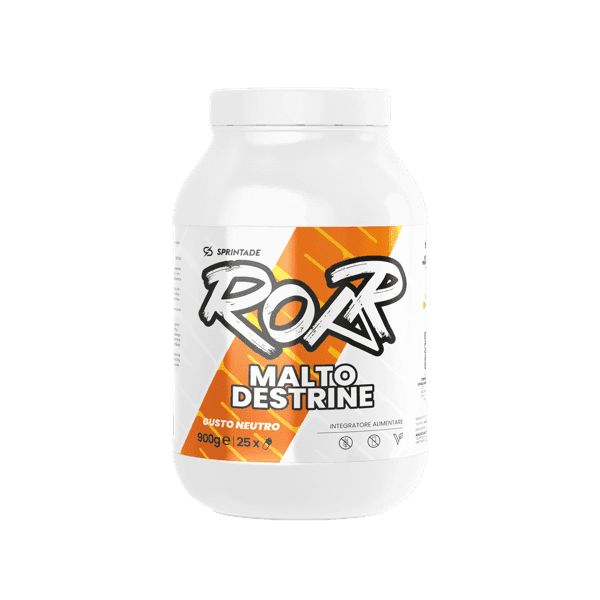


Maltodextrin

19,55 €
How to use: Dissolve 2 measuring spoons (equivalent to 36 g) of powder in 350 ml of water, preferably during or after physical activity.
Warnings: Do not exceed the recommended daily dose. Keep out of reach of children under 3 years of age. Food supplements are not intended as a substitute for a varied and balanced diet and a healthy lifestyle.
Storage conditions: Store in a cool, dry place, away from light and heat. The use-by date applies to the product when stored correctly in its unopened packaging. Close the container securely after use.
Pure DE19 maltodextrin for energy and endurance sports
Sprintade ROAR Maltodextrin D.E. 19 is a powdered dietary supplement consisting exclusively of maltodextrin, developed to increase carbohydrate intake simply and precisely before, during or after physical activity.
Each 36-gram serving provides 34.2 grams of carbohydrates. The powder, which is neutral in taste and free from flavourings and colourings, can be dissolved in water or combined with other products to create a personalised nutritional strategy.
ROAR Maltodextrin is particularly suitable for cycling, running, triathlon, team sports, intense training sessions and long-duration activities where the availability of carbohydrates can be a key factor in performance.
What are maltodextrins?
Maltodextrins are mixtures of glucose chains obtained through the controlled hydrolysis of starch. The source starch can come from various plant sources, such as maize, rice, potatoes or tapioca.
In the case of Sprintade ROAR, DE19 maltodextrin is used. The hydrolysis process partially breaks down the long starch chains, producing water-soluble carbohydrates that are easy to mix and rapidly digestible.
Although they consist of longer glucose chains than dextrose, maltodextrins should not be regarded as ‘slow’ carbohydrates. Once ingested, they are rapidly broken down by digestive enzymes and release glucose that can be used for energy.
What does DE19 mean?
The abbreviation DE stands for ‘Dextrose Equivalent’, a parameter that expresses the degree of starch hydrolysis.
A higher DE value generally corresponds to shorter average carbohydrate chains; a lower value indicates longer average chains. Maltodextrins normally fall within a DE range of 3 to 20, whilst values above this fall into the category of glucose syrups.
A DE19 maltodextrin is therefore close to the upper limit of the category: it has high solubility, a less sweet taste compared to dextrose and a rapidly digestible structure.
Why take maltodextrin whilst exercising?
During exercise, carbohydrates are one of the main substrates used to produce energy. The body can store them as glycogen in the muscles and liver, but these reserves are limited and are gradually depleted during prolonged activity.
Consuming carbohydrates during exercise can help maintain glucose availability and carbohydrate oxidation, particularly when the session lasts longer than 60–90 minutes.
For this reason, maltodextrin-based products are widely used by cyclists, marathon runners, triathletes and those undertaking intense or prolonged training sessions. They do not supply ATP directly and do not guarantee energy for a set number of hours: they provide carbohydrates that the body can use to produce energy depending on the intensity and duration of the exercise, as well as individual metabolism.
Maltodextrin or simple sugars: what are the differences?
Dextrose and maltodextrin both provide glucose that the body can utilise. The main difference lies in their molecular structure and the number of particles present in the solution.
For the same weight in grams of carbohydrates, maltodextrin has a higher average molecular weight than free glucose and contributes less to the osmolality of the drink. This makes it possible to prepare solutions containing a significant amount of carbohydrates that taste less sweet and generally have a lower osmotic pressure than a solution containing the same amount of glucose alone.
This does not mean that a drink containing maltodextrin is always absorbed more quickly. Gastric emptying and absorption also depend on the drink’s concentration, the volume consumed, the presence of other nutrients and individual tolerance.
Maltodextrin should therefore not necessarily be considered ‘better’ than simple sugars: it is a technically useful source of carbohydrates, which can be used on its own or combined with other carbohydrates depending on the type of activity and energy requirements.
Why choose Sprintade ROAR Maltodextrin?
Sprintade ROAR Maltodextrin contains just one ingredient: DE19 maltodextrin.
The formula has been developed for those seeking a pure, versatile and easily measured source of carbohydrates, with no added flavourings, colourings, vitamins or minerals.
Its main features are:
- maltodextrin DE19;
- 34.2 g of carbohydrates per serving;
- high solubility in water;
- neutral taste;
- just 2.9 g of sugars per serving;
- zero fat;
- no flavourings or colourings;
- suitable for a vegan diet;
- gluten-free;
- lactose-free;
- suitable for use before, during or after physical activity.
The 900-gram pack allows you to easily adjust the amount of product according to your training and nutritional plan.
How should ROAR Maltodextrin be taken?
Dissolve two scoops (equivalent to 36 grams) of powder in approximately 350 ml of water. This serving provides 34.2 grams of carbohydrates.
The concentration can be adjusted by increasing the volume of water, particularly during prolonged exercise or in hot weather. Your overall hydration strategy should take into account the temperature, your individual rate of sweating and any other products consumed.
Before training
Maltodextrin can be used before exercise to boost your carbohydrate intake when your previous meal was some time ago, insufficient or impractical.
The amount and timing of intake should be adjusted according to personal tolerance. It is advisable to test the drink during training before using it in a race.
During training or a race
During long-duration activities, ROAR Maltodextrin can be dissolved in a water bottle and consumed gradually.
Scientific guidelines generally recommend:
- approximately 30–60 g of carbohydrates per hour for activities lasting
- roughly between 1 and 3 hours;
- up to approximately 90 g/h during very prolonged events, using combinations of carbohydrates that can be absorbed via different intestinal pathways;
- higher amounts only as part of advanced protocols and following specific
- gastrointestinal training.
One serving of ROAR provides 34.2 g of carbohydrates and can therefore form the basis of a strategy of approximately 30–40 g/h. For higher targets, it is possible to increase the total amount or combine it with a source of fructose, always taking into account all carbohydrates from gels, drinks, bars and food.
After training
After exercise, carbohydrates help to replenish the glycogen stores depleted during the activity. Maltodextrin can be added to a post-workout drink and combined with a protein or amino acid source, depending on your nutritional goals.
Maltodextrin and preparing a weight gainer
ROAR Maltodextrin can be combined with protein powder and a drink of your choice to increase energy and carbohydrate intake.
This product may be useful for those who struggle to meet their calorie requirements through meals alone, or who are following a programme aimed at increasing body mass. However, the actual increase in muscle mass depends on training, energy balance and the overall intake of protein and nutrients.
Which supplements can maltodextrin be combined with?
ROAR Maltodextrin can be combined with:
- mineral salts, to create an energy and electrolyte drink;
- protein powders, as part of a post-workout shake;
- Sprintade Complete Amino;
- Sprintade BCAA 4:1:1;
- energy gels, when a higher hourly carbohydrate intake is required.
The combination should be chosen based on the activity, the duration of the workout and your overall requirements. Amino acids do not replace carbohydrates as the main energy source during endurance exercise, whilst maltodextrin does not replace the protein needed for muscle protein synthesis.
⎯
Frequently asked questions about maltodextrin
What is maltodextrin used for?
Maltodextrin makes it easy to increase your carbohydrate intake. It is mainly used before, during and after physical activity, as well as in diets requiring a higher energy intake.
Do maltodextrins provide immediate or sustained energy?
Maltodextrins are rapidly digested and release glucose that can be used to produce energy. They are not slow-release carbohydrates, and it is not possible to attribute a fixed duration of energy release to them, such as four hours or more.
Are maltodextrins sugars?
They are carbohydrates composed of chains of glucose. In the nutritional table, they are mainly counted as carbohydrates, whilst only the fraction consisting of simpler molecules is included under ‘of which sugars’. One serving of ROAR provides 34.2 g of carbohydrates, of which 2.9 g are sugars.
What is the difference between maltodextrin and dextrose?
Dextrose is glucose in its free form, whilst maltodextrins consist of glucose chains of varying lengths. At the same concentration, maltodextrins contribute fewer particles to the solution, have a less sweet taste and may contribute less to its osmolality.
What does ‘maltodextrin DE19’ mean?
DE19 indicates the degree of starch hydrolysis. It is a relatively high value for a maltodextrin and identifies a product consisting of carbohydrate chains that are, on average, shorter than those in maltodextrins with a lower DE.
Are maltodextrins suitable for cycling and running?
Yes. They are particularly practical for endurance sports because they can be dissolved in a water bottle and consumed gradually during exercise. The amount should be adjusted according to the duration, intensity and individual nutrition strategy.
How much maltodextrin should you take during training?
One serving of ROAR contains 34.2 g of carbohydrates. This may provide an adequate supply for an hour of moderately prolonged activity, whilst for longer events the target can be increased, taking other sources of carbohydrates into account as well.
When should you take maltodextrin?
It can be taken before exercise to increase the availability of carbohydrates, during exercise to sustain energy supply, or after training to aid glycogen replenishment.
Is maltodextrin soluble in water?
Yes. ROAR Maltodextrin DE19 is water-soluble and can be mixed with water. For the recommended dose, dissolve 36 g of powder in approximately 350 ml.
Are maltodextrins suitable for a vegan diet?
Yes. ROAR Maltodextrine is plant-based and has a formulation suitable for a vegan diet.
Can I mix maltodextrins and protein?
Yes. Combining them creates a drink containing both carbohydrates and protein, which is particularly useful after a workout or as part of a diet plan aimed at increasing energy intake.
Maltodextrin during a bulking phase and as a mass gainer
During a bulking phase, the aim is to create a controlled calorie surplus that supports an increase in body mass and, alongside appropriate strength training, an increase in muscle mass. Maltodextrin offers a practical solution for increasing carbohydrate and calorie intake without having to excessively increase the volume of meals.
One serving of Sprintade ROAR provides 34.2 grams of carbohydrates and approximately 139 kcal. It can be added to shakes, drinks or protein powders to prepare a personalised mass gainer, adjusting the amounts of carbohydrates and protein separately according to your individual needs.
To make a mass gainer, you can combine:
- 36–72 g of ROAR Maltodextrine;
- 25–35 g of protein powder;
- water, milk or a plant-based drink;
- optionally, fruit, nut butter or other energy-rich ingredients.
36 g of ROAR provides approximately 139 kcal; 72 g provides approximately 278 kcal. The product can be consumed after a workout or at another time of day when it is difficult to meet your calorie requirements through regular meals.
Maltodextrin does not directly increase muscle mass: it provides carbohydrates and energy. Muscle growth depends on a combination of training, an adequate calorie surplus, protein intake and recovery. An excessive surplus can also lead to an increase in body fat; for this reason, the amount must be tailored to individual goals and energy expenditure.
Is maltodextrin useful during a bulking phase?
Yes. It can help increase calorie and carbohydrate intake, especially when consuming other solid foods becomes difficult. It is particularly practical for athletes with high energy expenditure or for those wishing to prepare a mass gainer with personalised dosages.
How should maltodextrin be used as a mass gainer?
It can be mixed with a protein source and a liquid. The amount should be determined based on the required calories and carbohydrates: a 36 g serving provides 34.2 g of carbohydrates and approximately 139 kcal, whilst two servings provide 68.4 g of carbohydrates and approximately 278 kcal.
Is a ready-made mass gainer better, or is it better to use separate maltodextrin and protein?
Using separate maltodextrin and protein allows you to adjust the carbohydrate-to-protein ratio yourself. A ready-made mass gainer is more convenient, whilst a personalised mix allows you to tailor portions and calorie intake to the different stages of your diet plan.
Related products
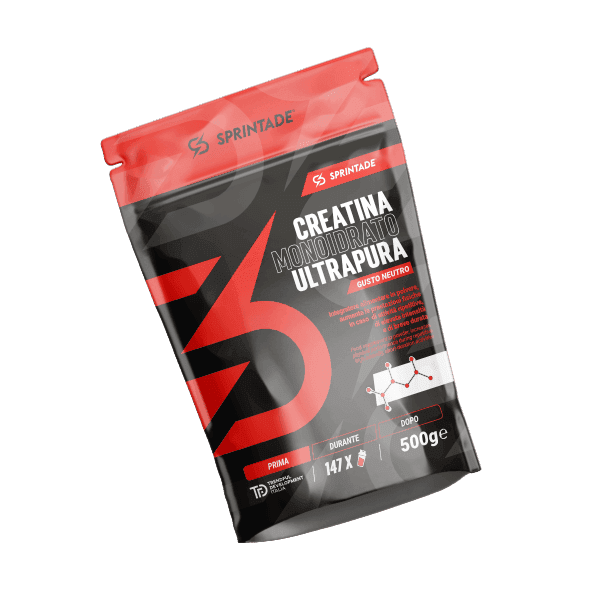
Creatina Monoidrato Ultrapura


BCAA 4:1:1